
Two ingredients headline every Slimqa Slim Coffee Booster stick: 100 mcg of chromium and 120 mg of caffeine. This guide explains what each one is, where you meet it in everyday food and drink, and how to read the numbers on the label.
If you have picked up a box of coffee sticks and wondered what the first two lines of the label actually mean, you are in the right place. Below we take chromium and caffeine one at a time, in plain words. For the whole product at a glance, see the Slimqa home page.
Chromium and caffeine at a glance
| Ingredient | Form | Per stick (2 g) | % DV |
|---|---|---|---|
| Chromium | Chromium picolinate | 100 mcg | 286% |
| Caffeine | Added to the powder | 120 mg | Not established |
Notice the units. Chromium is measured in micrograms (mcg) and caffeine in milligrams (mg). One milligram equals 1,000 micrograms, so 100 mcg of chromium is just 0.1 mg. That is normal: chromium is a trace mineral, and the body needs only tiny amounts of it.
What is chromium?
Chromium is an essential trace mineral, which means it is part of the human diet but in very small quantities. It is found in soil and water, and traces end up in the foods grown and raised with them. You have probably eaten some today without noticing: broccoli, whole wheat bread, potatoes, grape juice and a few spices all contain small amounts. Roughly speaking, a half cup of broccoli supplies around ten micrograms, while a serving of mashed potatoes or a slice of whole wheat toast supplies a couple.
The Daily Value (DV) used on US labels for chromium is 35 mcg. One stick contains 100 mcg, which works out to 286% of the Daily Value. A percentage over 100 simply tells you the stick has more than the reference amount; it is not a prompt for anything on its own. When you add food and any other supplements, the totals add up, so it is worth looking at every label you use.
Why chromium picolinate?
Chromium shows up in supplements in several forms. The Slimqa label lists chromium picolinate, in which chromium is bound to picolinic acid, a compound the body also produces. It is one of the most common forms on supplement shelves in the United States. We list what is on the label and leave it there: there is no need for a chemistry degree to read a Supplement Facts panel.
What is caffeine?
Caffeine is a naturally occurring compound found in coffee beans, tea leaves, cacao and kola nuts, and it is added to many sodas and energy drinks. It is the most widely consumed stimulant in the world, and in the United States most of it arrives in a mug. Each Slimqa stick adds 120 mg of caffeine to whatever you stir it into.
120 mg compared with a normal day of drinks
- A standard 8 oz cup of brewed coffee has roughly 95 mg.
- A 16 oz coffee from the drive-through is about two cups' worth, close to 190 mg.
- A single shot of espresso has around 63 mg.
- A 12 oz can of cola has about 34 mg.
- An 8.4 oz energy drink has around 80 mg.
Those are typical numbers and real products vary. A concrete example: if you add a stick to your regular 16 oz coffee, the whole mug lands somewhere in the neighborhood of 300 mg, so many people keep the rest of the day lighter or choose water for the stick. For routines that suit you, our guide on how to take Slimqa lists easy options.
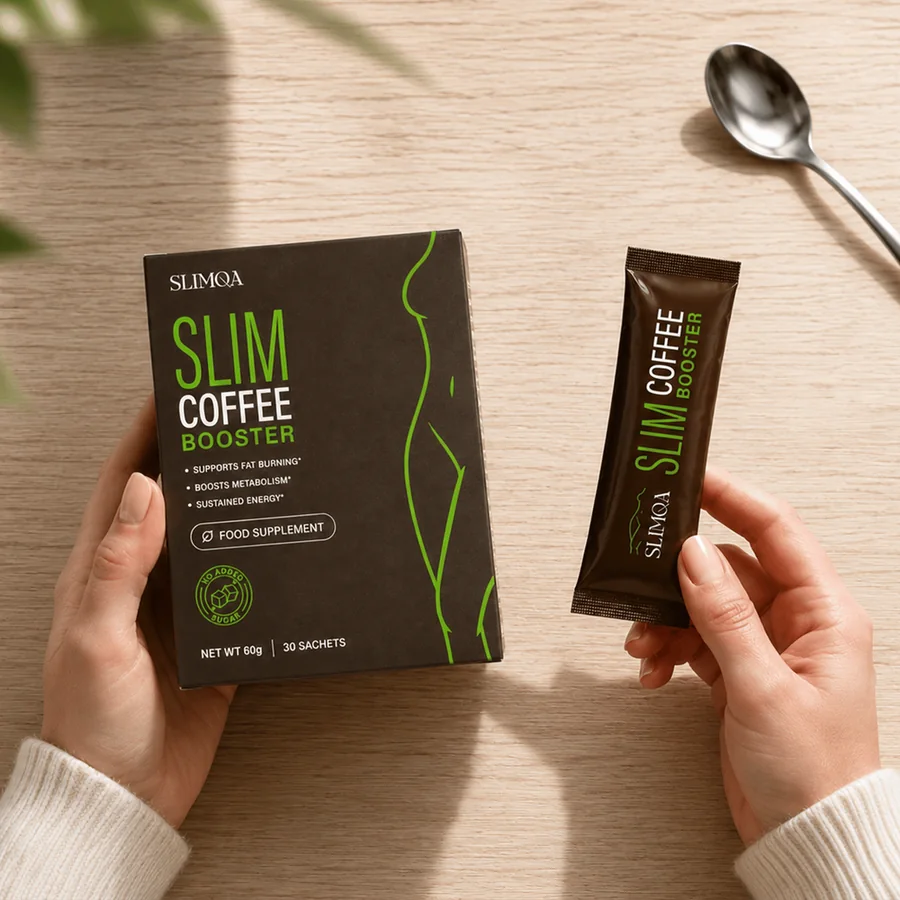
100 mcg of chromium and 120 mg of caffeine in every stick
Discover Slimqa now Dietary supplement. Contains 120 mg of caffeine per stick. Adults only (18+). Not a substitute for a varied, balanced diet.How much caffeine is too much?
There is no single answer. The FDA has cited 400 mg a day as an amount not generally associated with dangerous, negative effects in healthy adults, but individual sensitivity differs widely. A good habit is to write down, for one ordinary day, every source of caffeine: coffee, tea, soda, energy drinks, even some pre-workout powders. Then add the stick. Many people are surprised by the total.
Slimqa is not recommended for children, pregnant or nursing women, so please read our safety and suitability guide if any of that applies to you or to someone in your household.
What goes into the stick besides chromium and caffeine
The same 2 g stick holds three more active ingredients: 100 mg of green coffee bean extract, 300 mg of L-carnitine and 100 mg of curcumin from turmeric extract. They are described on their own pages, including green coffee bean extract and L-carnitine and curcumin. The other ingredients are inulin (chicory root fiber), natural flavor, stevia leaf extract and black pepper extract. Stevia gives the powder a hint of sweetness, and a stick contains just 5 calories.
Reading a Supplement Facts panel
A US Supplement Facts panel lists the serving size at the top, then each ingredient with its amount per serving and, where one exists, its percent of the Daily Value. For chromium that percentage is 286%. For caffeine, green coffee bean extract, L-carnitine and curcumin there is no Daily Value set, which is why you see an asterisk or a dash instead of a percentage. The order does not mean much beyond that; what matters is the amount.
A practical morning example
Say your usual routine is one mug of drip coffee at 7 a.m. and tea at lunch. You add a Slimqa stick to the 7 a.m. mug. Your caffeine for the day is now the mug (about 95 to 140 mg depending on size), the stick (120 mg) and the tea (about 47 mg): somewhere between 260 and 310 mg. That is within the FDA reference figure, yet more than a typical day for a one-cup drinker. Knowing the sum is the entire point.
Chromium on an ordinary American plate
Most people get chromium without ever thinking about it. A breakfast of whole wheat toast and a glass of grape juice, a turkey sandwich at lunch, and broccoli with a baked potato at dinner each add a few micrograms. Because soil, processing and cooking change the amounts, food tables give ranges rather than exact figures, and that is why nobody expects you to count it. The stick is different: its amount is printed, so you always know what you are adding.
Questions people ask at the shelf
- "Why 286%?" Because the reference amount is small. The Daily Value for chromium is 35 mcg and the stick has 100 mcg.
- "Is the caffeine from coffee?" The label lists caffeine as its own line, 120 mg per stick, and gives no source, so we do not describe one.
- "Does the stick taste like coffee?" It is a powder with natural flavor and stevia leaf extract. In a hot or iced coffee you will mostly taste your coffee.
- "Can I split a stick?" The serving is one whole stick a day, and the directions do not describe splitting it.
Frequently asked questions
How much chromium is in one Slimqa stick?
100 mcg of chromium as chromium picolinate, which is 286% of the Daily Value of 35 mcg.
How much caffeine is in one stick?
120 mg per stick. A typical 8 oz cup of brewed coffee has about 95 mg, so a stick contains a bit more than one cup.
Why is chromium listed in micrograms?
Chromium is a trace mineral needed in tiny amounts, so it is measured in micrograms. 100 mcg equals 0.1 mg.
Where do I find chromium in food?
Broccoli, whole wheat bread, potatoes, grape juice and some spices contain small amounts.
Does the Daily Value apply to caffeine?
No. There is no Daily Value for caffeine, so the label gives the amount in milligrams only.
Is there anything to watch when combining caffeine sources?
Yes. Add up every source you use in a day, such as coffee, tea, soda and energy drinks, together with the 120 mg in a stick.
More guides
Last reviewed October 20, 2026. This guide is general information about a dietary supplement.